Demolition concrete is one of the few waste streams that can leave site as a specified product the same week it is generated. Most of it still leaves as mixed skip waste, or as a dirty 0–80 pile nobody will certify. The difference is not “having a crusher.” It is running a circuit that assumes steel, timber and asphalt will show up in the same heap as the slab.
If you crush first and think later, you contaminate the stockpile, wreck wear parts, and train the next client to distrust recycled aggregate. If you design the line around what is actually in a building, recycled concrete aggregate (RCA) is a straightforward output: 0–20, 20–40, 40–70, with the steel in a skip and the timber out of the chamber.
What is in the pile (be honest)
A “concrete” heap on a demolition pad is rarely just concrete.
- Slab and foundations — crushable, often with mesh
- Beams and columns — crushable only after they are cut to feed size; whole cages are not feed
- Asphalt planings — fine as a designed stream, messy if they surprise an operator who set up for clean concrete
- Brick and block — usually acceptable in mixed C&D if the spec allows
- Timber, plastics, plasterboard, soils — not crusher feed; they belong in a pick or a shredder stream
- Rebar, mesh, pipe, embedded plates — magnet work, not hope
The plant does not fail because concrete is hard. It fails because uncrushables and organics are treated as a surprise.
The circuit that produces a saleable RCA
Keep it short. Extra machines do not make you look professional if the magnet is missing.
1. Pre-sort at the excavator. Pull obvious timber, plastic and oversize steel before the hopper. A picker on the ground is cheaper than a rotor repair.
2. Feed, don’t dump. A vibrating feeder meters the chamber. Surging a hopper “to keep up” is how you stall an impactor and spike diesel.
3. Crush for shape, not just size. For clean concrete and asphalt, a horizontal shaft impact crusher is usually the right first machine. Blow bars break paste off the stone and give a cubical product that sits in a road-base spec better than a slabby jaw product. A jaw still has a place as a primary on very large, heavily reinforced pieces — but recycling yards that need a finished aggregate in one pass typically live on impact.
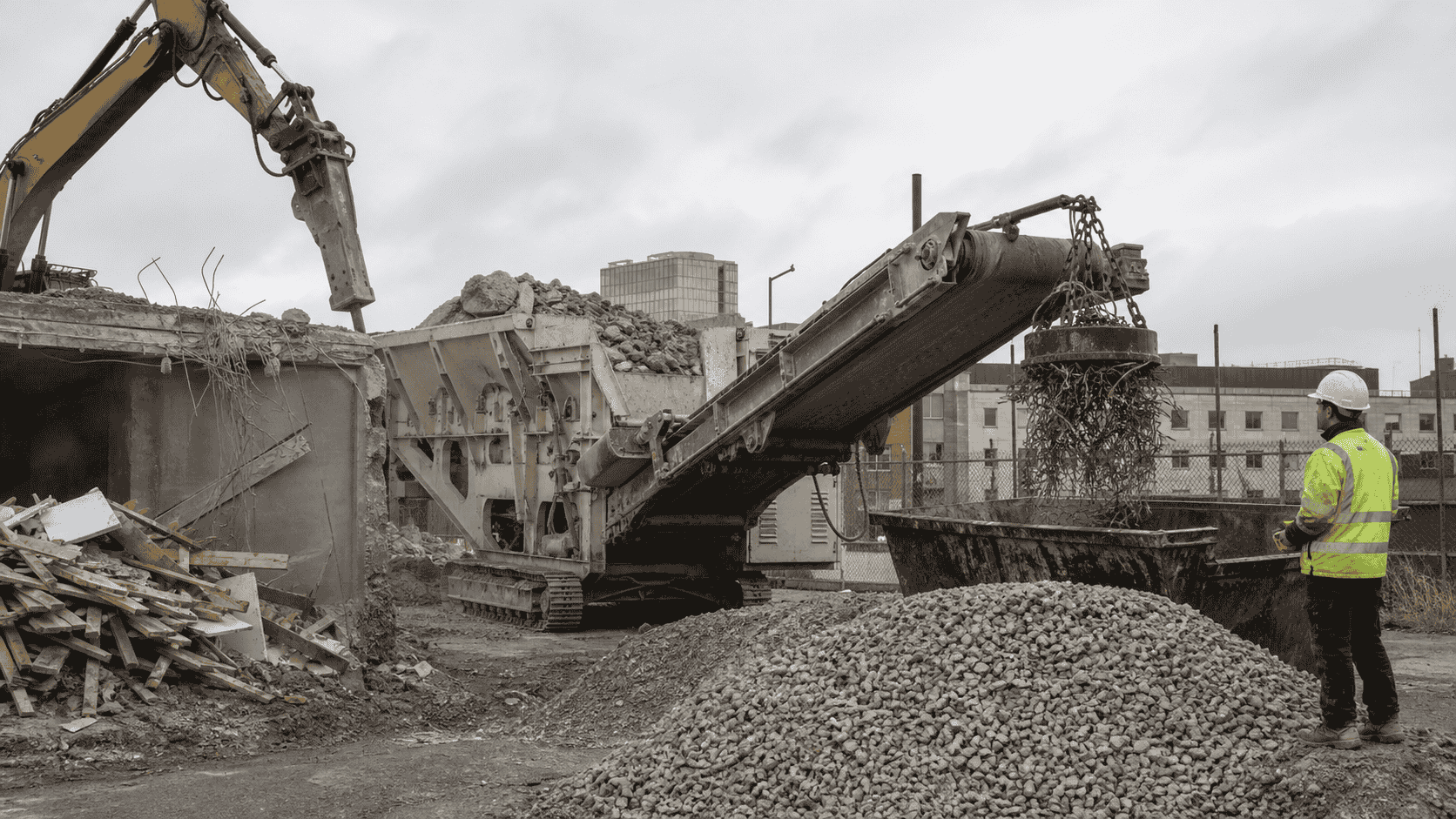
4. Magnet on the belt. Always. This is the line item amateurs skip. Rebar in the stockpile is a rejected load. Rebar in a secondary machine is a destroyed rotor. Overband magnets above the discharge conveyor are not optional on RC concrete.
5. Screen to a spec. “Crushed concrete” is not a product. 0–40 mm sub-base is a product. Split sizes if you have a market for them. Closed circuit the oversize back to the crusher. That loop is how the pile becomes consistent instead of “mostly fine with lumps.”
6. Stockpile clean. Do not drive through the product. Do not mix a Monday brick stream into a Tuesday clean-concrete pile if you told the buyer it was RCA.
On yards that move, or jobs that last weeks not years, that whole chain has to be mobile. Stationary recycling plants make sense when the gate is fixed. Most demolition contracts are not a gate. They are a slab, a permit window, and a neighbour who will call the council about noise. That is why mobile impact crushers with a magnet option and a matching screener show up on serious C&D jobs — not because mobility is fashionable, but because the feed is on a floor that will be someone else’s car park in six weeks.
Jaw or impact on demolition?
Use a jaw when feed is large, blocky, very hard, or you need a robust primary before a second stage. Heavy foundations and big RC pieces often start in a jaw.
Use an impact when you want cubical recycled aggregate from concrete and asphalt, and you can pull steel. This is the default recycling chamber.
Use a trailer plant when the machine has to arrive on a city street, work a tight pad, and leave without a heavy haul every time. Capacity will be lower. Utilisation on short jobs is the point.
Do not buy peak tonnes per hour for a demolition contract that is actually limited by the excavator, the permit hours, and how fast you can cut steel.
Contamination is a commercial problem
Buyers of recycled aggregate remember the load that had timber in it. One dirty delivery trains them to go back to virgin stone.
- Plasterboard and soils wreck freeze-thaw and unbound specs. Keep them out of the hopper.
- Mixed brick may be acceptable for some fill products and unacceptable for others. Label piles.
- Asphalt content changes the product. Some markets want it; some specs cap it. Know which job you are on.
- Water: wet, clayey feed packs impact chambers and blinds screens. You cannot crush your way out of a drainage problem.
If the incoming stream is truly mixed C&D, you may need a shredder or a separate picking line before anything sees a crusher. Putting a whole house through an impactor is not recycling. It is a maintenance event.
What “good” looks like on the cost sheet
A working recycling pad should show:
- fewer tonnes to landfill
- fewer tonnes of imported sub-base
- a magnet skip that actually fills (that means the magnet is working)
- wear-part changes on a schedule, not as emergencies
- product that matches what you sold, not what happened to come out on Thursday
Blow bars are a regular cost on impact recycling plants. Budget them. A cheap plant with no bar stock in the country is not cheap. Same for liner and feeder pans.
Service life on a well-built mobile plant is measured in years and hours, not in the colour of the paint. What kills machines on demolition sites is tramp steel, feeding uncut cages, running liners to zero, and parking hydraulics in slurry.
Before you hire or buy
Send the supplier photos of the actual heap, max piece size, whether beams are being cut, product sizes the buyer asked for, and whether the plant must track or tow. If they quote without that, you are buying a brochure.
Recycled concrete is only waste if you process it like waste. Treat it like a small quarry with a magnet and a spec, and it stops being a disposal line on the demolition account.