
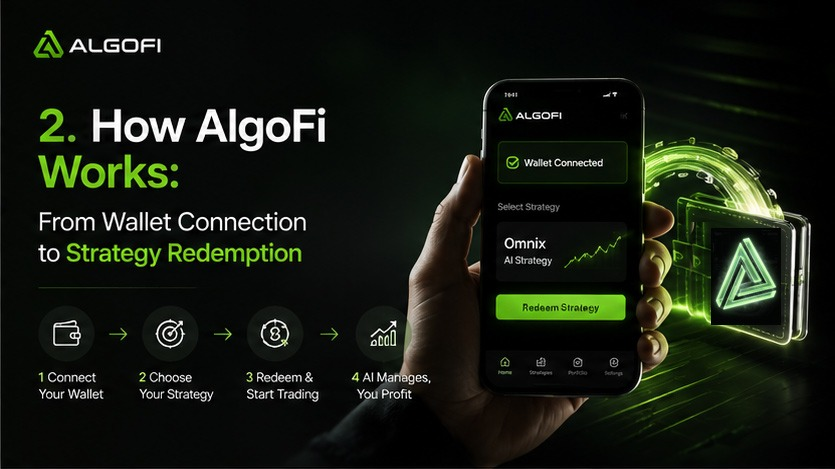
The process of using a wallet-connected trading platform can appear simple from the outside: connect a wallet, deposit funds, select a strategy, and begin. In practice, however, there are several important stages between depositing capital and eventually withdrawing it. Understanding those stages is particularly important when systematic trading, managed execution, custody, risk controls, and redemption timelines are involved.
AlgoFi is a wallet-connected platform that gives users access to systematic trading strategies through a structured allocation process. Users can connect a supported Web3 wallet, deposit supported assets, review available strategies, select a strategy and risk level, allocate capital, and monitor their portfolio through the platform. When they decide to exit a strategy, the process moves through redemption and a seven-day cooling period before the redeemed capital becomes available for external withdrawal.
The complete process can be summarized as:
Connect Wallet → Deposit Supported Assets → Review Strategies → Select Strategy and Risk Level → Allocate Funds → Strategy Operates → Monitor Portfolio → Request Redemption → Seven-Day Cooling Period → Available Balance → External Wallet Withdrawal
Each of these stages serves a different purpose. Understanding where capital sits, how it is managed, and what happens when a user wants to exit is essential to understanding how AlgoFi works as a whole.
What Is AlgoFi?
AlgoFi is a wallet-connected platform designed to provide access to systematic trading strategies without requiring users to manually manage every trading decision themselves. Instead of individually analyzing markets, selecting every entry and exit, determining position sizes, and continuously monitoring execution, users can allocate capital to a strategy that operates according to predefined methodologies and risk parameters.
AlgoFi currently provides access to six systematic strategies: Tenzor, Nuvex, Drav, Yark, Xylo, and Omnix. These strategies are designed around different methodologies and risk characteristics rather than relying on one universal trading rule. This distinction matters because financial markets do not behave the same way under every condition. A methodology that responds effectively to a trending environment, for example, may behave differently during periods of lower volatility, changing correlations, or range-bound price action.
AlgoFi therefore should not be understood simply as a trading bot that generates occasional buy or sell signals. The platform combines strategy selection, capital allocation, systematic execution, risk management, portfolio monitoring, redemption, and withdrawal into a broader managed trading process. Automation can make execution more systematic, but it does not remove market risk or guarantee profitable results.
Step 1: Connecting a Web3 Wallet
The AlgoFi process begins when a user connects a supported Web3 wallet. The wallet acts as the primary access point through which the user interacts with the platform and initiates supported transactions. Connecting a wallet allows the user to access the relevant platform functionality and proceed toward depositing supported assets.
There is, however, an important distinction between wallet connection and custody. A wallet-connected platform is not automatically a fully non-custodial platform. Connecting a wallet to AlgoFi does not mean that funds remain exclusively inside that external wallet after they have been deposited and allocated to a strategy.
AlgoFi is therefore more accurately described as wallet-connected rather than fully non-custodial. This distinction should be understood before capital is deposited because it explains what happens later when funds enter the platform’s managed trading environment.
Step 2: Depositing Supported Assets
After connecting a wallet, a user can deposit supported assets into AlgoFi. At this stage, it is useful to distinguish between depositing capital and allocating capital to a strategy. A deposit makes funds available within the platform, while strategy allocation is the separate step through which those funds become associated with an active trading strategy.
Before initiating a transfer, users should verify the supported asset and blockchain network currently displayed by AlgoFi. Blockchain transfers generally cannot be treated like conventional payment reversals, so selecting the correct asset, wallet address, and supported network is an important part of the deposit process.
Once the deposit has been successfully reflected on the platform, users can review the available strategies and determine how, or whether, they want their capital allocated.
Step 3: Reviewing AlgoFi’s Six Strategies
AlgoFi currently offers six systematic strategies: Tenzor, Nuvex, Drav, Yark, Xylo, and Omnix. Rather than selecting a strategy solely because of its most recent performance, users should evaluate the broader characteristics of the strategy, including its methodology, risk profile, historical drawdown behavior, applicable fees, and performance across different market environments.
This matters because markets continually change. Volatility can expand or contract, correlations between assets can shift, liquidity conditions can deteriorate, and markets can transition between trending and range-bound environments. As a result, historical performance from one period cannot be assumed to repeat under a different market regime.
Strategy selection should therefore be approached primarily as a methodology and risk decision, rather than simply a search for whichever strategy has recently produced the highest return. Historical performance can provide useful context, but it should always be considered alongside risk and should never be interpreted as a guarantee of future results.
Step 4: Selecting a Strategy and Risk Level
After reviewing the available strategies, users can select the strategy and available risk configuration that they consider suitable for their objectives and tolerance for volatility. The purpose of risk selection is not simply to choose between lower and higher potential returns. It also determines how much fluctuation and potential drawdown a user may be willing to accept.
For this reason, a better question than “Which AlgoFi strategy has performed best recently?” is “Which strategy and risk profile are appropriate for the level of volatility, drawdown, and potential loss I am prepared to accept?” That distinction encourages users to consider the relationship between risk and return instead of focusing only on historical performance.
Higher-risk configurations may involve greater fluctuations in portfolio value and potentially larger drawdowns. Choosing a risk level does not create a guaranteed return or ensure that losses cannot exceed a user’s expectations. Users should therefore evaluate their financial circumstances, liquidity requirements, and risk tolerance before making an allocation decision.
Step 5: Allocating Capital to a Strategy
Once a user has selected a strategy and risk level, capital can be allocated to that strategy. This is the point at which funds move from being available on the platform to becoming part of an active strategy allocation.
From this stage onward, individual trading decisions are governed by the strategy’s predefined methodology and risk framework. The user is not manually approving every entry, exit, or position adjustment. Instead, the selected strategy determines trading actions according to the logic and parameters associated with that strategy.
This division of responsibility is central to understanding the AlgoFi model. The user determines whether to allocate capital and which available strategy to select, while the systematic strategy is responsible for individual trading decisions within its predefined framework.
Step 6: How Funds Are Managed While a Strategy Is Active
Once capital has been allocated, it enters AlgoFi’s managed trading environment and may be deployed through AlgoFi’s operational infrastructure and approved third-party providers as part of strategy execution. At this point, the allocated assets should not be understood as remaining exclusively inside the user’s connected external wallet.
This creates an important distinction between a connected wallet, strategy balance, and Available Balance. The connected wallet is the external wallet through which the user interacts with AlgoFi. Strategy Balance represents capital currently associated with an active strategy, while Available Balance represents funds within the platform that are not currently allocated to an active strategy and may be eligible for external withdrawal under the applicable procedures.
Understanding these different balances can prevent one of the most common sources of confusion in wallet-connected trading platforms: assuming that all funds shown in connection with an account are in the same state or immediately available for external transfer.
Step 7: How AlgoFi’s Systematic Strategies Operate
Once funds have been allocated, the selected strategy operates according to its predefined methodology. Systematic trading is designed to make trading decisions according to established rules and parameters rather than requiring discretionary decisions for every individual trade.
This can reduce certain forms of human inconsistency. A systematic strategy does not become impatient after several quiet trading sessions or change its methodology simply because the previous trade resulted in a loss. Instead, it continues to operate according to the conditions, signals, execution logic, and risk parameters built into the strategy.
That consistency, however, should never be confused with certainty. Financial markets can behave differently from the conditions on which a strategy was designed or tested. Volatility, liquidity, correlations, macroeconomic conditions, and market structure can all change. A strategy can therefore execute exactly as intended and still experience periods of underperformance, drawdowns, or losses. Automation standardizes a process; it does not eliminate the financial risk associated with that process.
Step 8: Monitoring an AlgoFi Portfolio
While a strategy remains active, users can monitor the performance of their portfolio through AlgoFi. Portfolio monitoring provides visibility into the status and performance of an allocation without requiring the user to manually control each individual trading decision.
Monitoring should therefore be distinguished from trade-by-trade management. Users can evaluate how their allocation is performing, but they are not expected to approve or reject individual trades in real time. The selected strategy continues operating according to its systematic framework while the allocation remains active.
This allows users to focus on the broader questions that matter at the portfolio level: whether the strategy continues to fit their risk tolerance, how the allocation is performing, whether drawdowns remain acceptable to them, and whether they want to maintain or exit the strategy.
How Do You Exit an AlgoFi Strategy?
When a user decides to exit an active strategy, the first step is to submit a redemption request. This is an important point because redemption and external withdrawal are two different stages of the process.
A redemption request tells AlgoFi that the user wants to remove capital from an active strategy allocation. It does not mean that the funds are immediately transferred to the user’s external wallet. Instead, submitting the redemption request begins AlgoFi’s applicable cooling period.
Understanding this distinction is important for liquidity planning. Users should not assume that pressing an exit or redemption option means that the corresponding capital will immediately become available outside the platform.
What Is AlgoFi’s Seven-Day Cooling Period?
AlgoFi currently applies a seven-day cooling period after a strategy redemption request is submitted. During this period, the redeemed capital is no longer actively deployed in the strategy, but it has not yet moved into the user’s Available Balance for external withdrawal.
The cooling period should therefore be considered before capital is allocated, especially when a user may need access to that money within a short timeframe. Capital allocated to an AlgoFi strategy should not be treated as funds that can necessarily be transferred back to an external wallet immediately after an exit decision.
Once the seven-day cooling period has been completed, the redeemed funds move into the user’s Available Balance. At that point, they are no longer allocated to the strategy or subject to the strategy-redemption cooling period.
Redemption vs. Withdrawal: What Is the Difference?
Although the terms can sound similar, redemption and withdrawal describe two separate actions within AlgoFi. Redemption removes capital from an active strategy and begins the seven-day cooling period. Withdrawal occurs later, after the cooling period has finished and the redeemed funds have moved to Available Balance.
The complete exit process therefore follows this sequence:
Active Strategy → Redemption Request → Seven-Day Cooling Period → Available Balance → External Wallet Withdrawal
This distinction helps explain why submitting a redemption request should not be interpreted as confirmation that funds have already been sent to an external wallet. The strategy must first be exited through the redemption process; the external withdrawal is a separate action that follows afterward.
What Happens After the Cooling Period?
After the seven-day cooling period is completed, redeemed capital moves to Available Balance. The user can then submit a separate withdrawal request to transfer eligible funds from AlgoFi to a supported external wallet.
External withdrawal processing can depend on applicable operational checks, blockchain conditions, network activity, and the platform’s current withdrawal procedures. Users should therefore review the latest information shown by AlgoFi when submitting a withdrawal rather than assuming that every transaction will have an identical processing time.
This completes the full capital lifecycle: funds enter through a connected wallet, move through deposit and strategy allocation, operate within the selected systematic strategy, return through redemption and Available Balance, and can then be requested for withdrawal to an external wallet.
Is AlgoFi Custodial or Non-Custodial?
AlgoFi is wallet-connected but not fully non-custodial. The distinction is important because users initially interact with the platform through their own Web3 wallet, but allocated capital does not remain exclusively inside that wallet while a strategy is active.
Once supported assets are deposited and allocated, they enter AlgoFi’s managed trading environment and may be deployed through its operational infrastructure and approved third-party providers. The external wallet therefore functions as an important interaction and transaction endpoint, while active strategy capital is managed within the platform’s trading infrastructure.
Clear custody terminology is particularly important in digital-asset platforms because “connect your wallet” can sometimes create the impression that assets never leave the user’s direct wallet environment. Users should understand the actual structure before allocating capital rather than making assumptions based solely on the wallet-connected interface.
Does AlgoFi Guarantee Returns?
No systematic or automated trading strategy can eliminate market risk, and AlgoFi strategies should not be interpreted as guaranteeing returns. Historical results, backtests, simulations, or previous live performance can provide useful information about how a methodology behaved under certain market conditions, but they cannot establish what will happen in the future.
Financial markets are dynamic. Strategies can experience profitable periods as well as periods of lower performance, increased volatility, drawdowns, or losses. Changes in market structure, liquidity, volatility, correlations, and broader economic conditions can all affect strategy performance.
For that reason, users should evaluate more than historical return figures. Strategy methodology, risk controls, drawdown characteristics, liquidity requirements, and personal risk tolerance are all relevant considerations when deciding whether an allocation is appropriate.
What Should Users Understand Before Allocating Funds?
Before allocating capital to AlgoFi, users should understand the complete lifecycle of their funds. This includes knowing which strategy they are selecting, the associated risk characteristics, how historical performance should be interpreted, what fees may apply, where capital is managed after allocation, and what process must be followed when they decide to exit.
Liquidity is particularly important. A user who may need immediate access to capital should consider the seven-day redemption cooling period before making an allocation. Similarly, historical returns should never be considered independently from drawdowns and potential losses. A strategy’s previous performance may be useful when evaluating it, but it cannot guarantee future profitability.
The objective should be to understand both the potential opportunity and the mechanics and risks involved before capital is committed.
Frequently Asked Questions About AlgoFi
How does AlgoFi work?
AlgoFi allows users to connect a supported Web3 wallet, deposit supported assets, review available systematic trading strategies, select a strategy and risk level, and allocate capital. Once allocated, the selected strategy operates according to its predefined methodology within AlgoFi’s managed trading environment. Users can monitor their portfolio and later request redemption if they want to exit the strategy.
What is AlgoFi?
AlgoFi is a wallet-connected platform that provides access to systematic trading strategies and portfolio-management functionality. Users can allocate funds to available strategies, monitor strategy performance, redeem an active allocation, and subsequently request withdrawal of eligible Available Balance to a supported external wallet.
How many strategies does AlgoFi offer?
AlgoFi currently provides six systematic strategies: Tenzor, Nuvex, Drav, Yark, Xylo, and Omnix. Each strategy has its own methodology and risk characteristics, meaning users should evaluate more than recent historical performance when deciding which strategy may be appropriate for them.
Is AlgoFi custodial or non-custodial?
AlgoFi is wallet-connected but is not fully non-custodial. Users interact with the platform through an external Web3 wallet, but once funds are deposited and allocated to a strategy, the capital enters AlgoFi’s managed trading environment rather than remaining exclusively inside the user’s external wallet.
Where are funds while an AlgoFi strategy is active?
Once funds have been deposited and allocated to a strategy, they enter AlgoFi’s managed trading environment and may be deployed through AlgoFi’s operational infrastructure and approved third-party providers. They should therefore not be considered as remaining exclusively within the user’s connected external wallet while actively allocated.
Can users choose their AlgoFi strategy?
Yes. Users can review AlgoFi’s available strategies and select a strategy and available risk configuration before allocating capital. Strategy selection should take into account methodology, historical performance, drawdown behavior, risk characteristics, fees, and the user’s own risk tolerance.
Can users lose money with AlgoFi?
Yes. Systematic trading involves market risk, and losses are possible. Automation does not guarantee profitability or eliminate drawdowns. Even when a strategy executes according to its intended methodology, changing market conditions can result in negative performance.
Does AlgoFi guarantee monthly returns?
No. Historical, backtested, simulated, or previous live results should not be interpreted as guaranteed future returns. Market conditions change, and future strategy performance may differ materially from historical performance.
What is an AlgoFi redemption?
A redemption request is the process through which a user requests to exit an active strategy allocation. Submitting a redemption begins the applicable seven-day cooling period; it does not immediately transfer the funds to the user’s external wallet.
How long is the AlgoFi cooling period?
AlgoFi currently applies a seven-day cooling period after a strategy redemption request is submitted. Once the cooling period is completed, the redeemed funds move to Available Balance, from which an eligible external-wallet withdrawal can subsequently be requested.
Is redemption the same as withdrawal?
No. Redemption and withdrawal are separate actions. Redemption exits capital from an active strategy and begins the seven-day cooling period. Withdrawal occurs after the cooling period has finished and the redeemed capital has moved to Available Balance.
How do I withdraw funds from AlgoFi?
If capital is currently allocated to a strategy, the user first submits a redemption request. After the seven-day cooling period is completed, the redeemed funds move to Available Balance. The user can then submit a separate withdrawal request to transfer eligible funds to a supported external wallet.
Can automation eliminate trading risk?
No. Automation can help a strategy execute predefined rules consistently, but it cannot eliminate market risk. A systematic strategy can operate exactly as designed and still experience losses when market conditions move against its methodology.
The Bottom Line
Understanding AlgoFi requires looking beyond the initial wallet connection. The complete process involves connecting a wallet, depositing supported assets, reviewing available strategies, selecting an appropriate strategy and risk level, allocating capital, allowing the systematic strategy to operate, monitoring portfolio performance, and eventually using the redemption and withdrawal process when the user decides to exit.
Several distinctions are particularly important. Wallet connection does not mean allocated funds remain exclusively inside an external wallet. Strategy allocation means capital enters AlgoFi’s managed trading environment. Redemption does not mean that funds have already been withdrawn externally, because a seven-day cooling period applies before redeemed capital reaches Available Balance. Most importantly, systematic execution does not remove the underlying possibility of trading losses.
For anyone evaluating AlgoFi, the most useful questions are therefore broader than simply asking how much a strategy has returned historically. Users should understand how the strategy operates, what level of risk they are accepting, where their capital is managed while the strategy is active, what happens when they request redemption, and how the complete withdrawal process works. Understanding these mechanics before allocating capital provides a much clearer basis for making an informed decision.
Risk Disclosure
Trading and investment strategies involve risk and may result in partial or complete loss of capital. Historical, backtested, simulated, or previous performance does not guarantee future results. Market conditions can change materially, and systematic or automated execution does not eliminate market risk.
Users should independently consider their financial circumstances, objectives, liquidity requirements, and risk tolerance before allocating capital. This article is provided for educational and informational purposes and should not be interpreted as a guarantee of performance or individualized investment advice.