
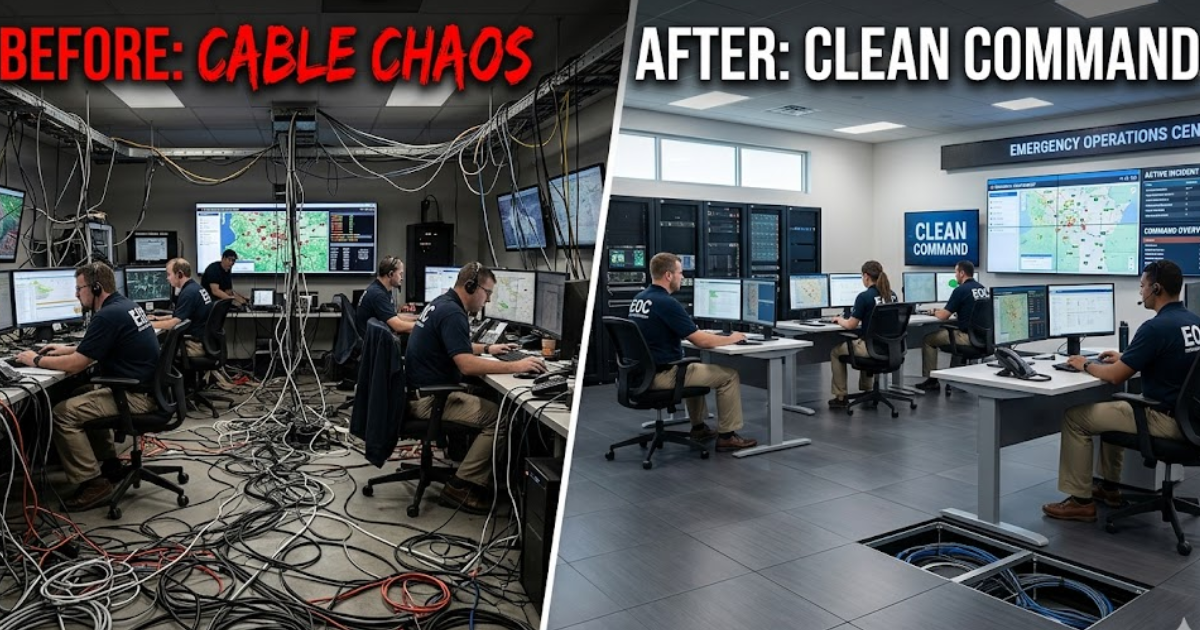
Picture the scene: it’s 2:47 a.m., and a dispatcher in a busy 911 center is simultaneously coordinating a multi-vehicle accident on the highway, a structure fire two miles away, and a medical emergency at an assisted living facility. Screens are live, radios are active, and every second carries real consequences. The last thing anyone in that room needs is a cable snaking across the floor, a system that goes dark because a technician disturbed a connection, or an infrastructure overhaul that pulls workstations offline for days.
Yet for many Emergency Operations Centers (EOCs), 911 dispatch facilities, and command posts across the country, cable chaos is exactly what’s lurking beneath, and sometimes on top of, the floor. As these facilities expand their communication systems, add bandwidth, and integrate new technology to serve growing populations, the infrastructure holding it all together is often straining to keep pace. Low-profile raised flooring offers a purpose-built solution: organized cable pathways, exceptional flexibility, and a clean, safe environment within a system that typically sits just 1.6″ to 2.75″ above the subfloor.
The Hidden Crisis in Emergency Operations Rooms
EOCs and dispatch centers operate around the clock in environments that are perpetually upgrading. New consoles replace old ones. Communication standards evolve. Staffing configurations shift. And every change requires more cable for power feeds, network runs, fiber, and AV, all of which must go somewhere.
In facilities relying on surface-run cabling or conventional cable trays, the accumulation over time creates real problems. Exposed cable runs pose a tripping hazard in a room where staff are moving quickly under pressure. Tangled pathways make maintenance and troubleshooting far more time-consuming than they need to be. Aesthetically, the clutter contributes to operator fatigue and diminishes the professional character that mission-critical environments demand. And when a technology refresh is needed, the disruption to live operations can be significant, especially in a facility that simply cannot afford to go offline.
What Is Low-Profile Raised Flooring?
Low-profile raised flooring creates a shallow plenum between the structural subfloor and the finished walking surface, a protected channel through which power and data cables can be routed cleanly and accessibly, with far greater organization than surface alternatives allow.
The Gridd® Adaptive Cabling Distribution® System is engineered specifically for this application. Available in 1.6″ (Gridd40, with 1.45″ of usable space) and 2.75″ (Gridd70, with 2.6″ of usable space) heights, Gridd uses lightweight, all-steel modular panels that install at up to 1,000 square feet per installer per day, as it requires no special tools or fasteners. For EOCs that cannot tolerate extended downtime, the installation speed is a critical advantage.
Key Benefits of Low-Profile Raised Flooring in Emergency Operations
The advantages of low-profile raised flooring are especially meaningful in life-safety environments:
- Safety and Cleanliness: Hidden cable pathways eliminate tripping hazards and remove visual clutter that contributes to operator stress in high-intensity situations.
- Flexibility and Scalability: Modular panels lift out without tools, enabling moves, adds, and changes as technology evolves, without disrupting the operators working just across the room.
- Operational Reliability: Easier access to cable infrastructure means faster troubleshooting and maintenance without taking workstations offline.
- Improved Ventilation: Even a shallow plenum improves airflow around densely packed consoles, helping manage heat dissipation in 24/7 environments.
- Space Efficiency: Sitting just 1.6″–2.75″ high, Gridd preserves ceiling height and is cost-effective for retrofits without triggering structural modifications.
- Lower Total Cost of Ownership: Faster installation reduces labor costs, and the system’s adaptability reduces long-term maintenance and reconfiguration expenses.
- Ergonomics and Morale: A clean, organized, professional environment supports the focused performance that round-the-clock emergency teams depend on.
Real-World Applications in Emergency and Command Centers
Low-profile raised flooring is well-suited to a wide range of mission-critical environments. Consider a few scenarios:
911 Dispatch Centers and PSAPs: A Public Safety Answering Point serving a mid-sized metro area upgrades its CAD system and doubles its console count. With Gridd®, new power and data runs are routed through the floor plenum over a weekend. Monday morning, operators return to a reconfigured room with no exposed cabling, no disruption to adjacent workstations, and no tripping hazards.
City and County EOCs: A county emergency management agency modernizes its coordination room ahead of hurricane season. The Gridd system accommodates both permanent workstations and the surge capacity needed when activation staff triples during a major event — with power and data accessible at any point on the floor.
Military and Homeland Security Command Posts: Sensitive facilities that demand both operational readiness and rigorous cable security benefit from Gridd’s fully enclosed pathways, which protect cable infrastructure from accidental disturbance and support rapid reconfiguration as mission requirements evolve.
Hospital command centers and critical infrastructure facilities face similar demands, and similar benefits. To see how Gridd has been deployed in real projects, visit the FreeAxez Projects page.
Low-Profile vs. Traditional Raised Floors: Which Is Right for Your EOC?
Not every facility has the same needs, but for most of the modern command and dispatch environments, Gridd’s low-profile raised flooring offers the right balance of performance, cost, and practicality. Here’s how the different options compare:
| Factor | Low-Profile Raised Floor (Gridd®) | Traditional Raised Floor | Surface Cabling |
|---|---|---|---|
| Height Above Subfloor | 1.6″–2.75″ | 12″–36″+ | 0″ (no plenum) |
| Ceiling Height Impact | Minimal | Significant | None |
| Installation Speed | ~1,000 sq ft/day per installer | Slower; heavier components | Fast, but disorganized |
| Cable Management | Structured, organized channels | High capacity, deeper void | Exposed; tripping hazard |
| Retrofit Suitability | Excellent | Disruptive; often impractical | Easy but unsafe |
| Airflow/Cooling | Improved ventilation at consoles | Full underfloor air distribution | None |
| Reconfigurability | Tool-free panel removal | Complex; specialized labor | Minimal |
| Best For | Modern EOCs, command centers, offices | Legacy data centers, large raised floors | Low-budget, temporary setups |
Full-height traditional systems remain appropriate for legacy data centers and facilities with large underfloor air distribution requirements. For nearly every modern EOC, command room, or dispatch center, low-profile is the right answer.
Implementation Tips and Best Practices
Planning a low-profile raised floor project in an active emergency facility? Keep these considerations in mind:
- Load-bearing requirements: Gridd® is available in three load-bearing configurations to accommodate the concentrated weight of heavy dispatch consoles, server racks, and multi-monitor workstations. Confirm specifications early in the design phase.
- Flooring finish selection: Choose from LVT, carpet tile, or anti-static finishes depending on your facility’s operational and maintenance needs. Anti-static options are particularly relevant in electronics-dense environments.
- Phased installation: Because Gridd installs at up to 1,000 square feet per installer per day with no special tools or fasteners, work can proceed in zones — keeping adjacent areas operational throughout the project. This is critical in 24/7 facilities.
- Future-proofing: Gridd’s modular design is backward compatible, meaning new panels, channels, and power components can be added as technology evolves. The system can even be relocated to another facility if needed, providing an unusual level of infrastructure flexibility.
- Experienced partners: Work with contractors familiar with Gridd systems and the specific demands of mission-critical environments to ensure minimal disruption and maximum performance from day one.
From Cable Chaos to Clean Command
Emergency operations depend on speed, reliability, and clarity. The infrastructure supporting those operations should too. Low-profile raised flooring eliminates the cable hazards, operational fragility, and reconfiguration headaches that hold too many EOCs back by replacing them with organized pathways, tool-free adaptability, and a clean environment that reflects the professionalism of the teams working within it.
In an era of increasing disaster frequency, complex multi-agency coordination, and relentless technology change, investing in smarter infrastructure is investing in better outcomes. For facility managers, architects, and emergency planners evaluating their next upgrade or new build, low-profile raised flooring deserves a central place in the conversation.
Ready to bring clean command to your facility? Contact a Gridd Advisor today to schedule a consultation and see how Gridd can help with your next emergency operations project.