

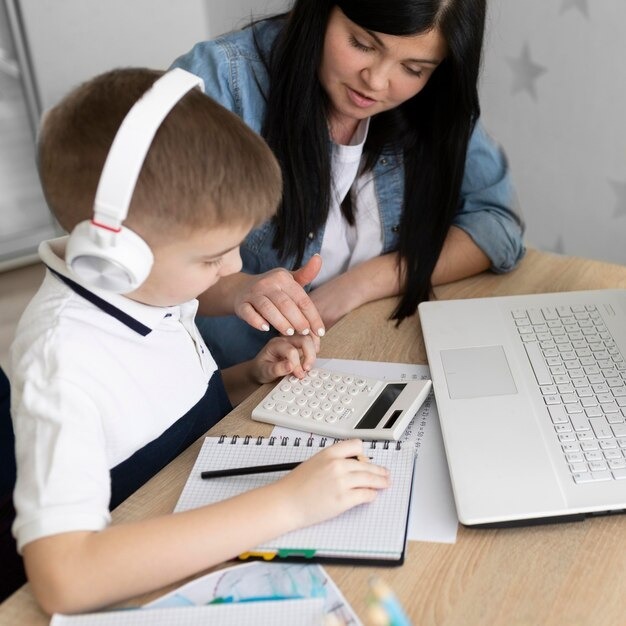
Calculators have long been essential tools in the realm of education, transforming the way students and teachers approach mathematical challenges. Over the years, these devices have evolved from simple arithmetic aids to highly sophisticated tools capable of handling complex computations. This progress has ushered in a new era of learning, where calculators are seen as critical educational resources. For more on different types of calculators available, visit the calculators category.
The Historical Context
The journey of calculators began in earnest during the 1960s, with the introduction of the first electronic calculators. These early devices were bulky and expensive, primarily used by businesses. However, their potential in education was soon recognised, and smaller, more affordable models made their way into classrooms during the 1970s.
By the 1980s, calculators had become staples in educational settings, aiding students with their arithmetic and algebraic problems. The growing accessibility of these tools marked a significant shift in educational practices, allowing students to focus more on problem-solving skills rather than manual calculations.
Advancements in Calculator Technology
With technological advancements, calculators have become increasingly sophisticated. Modern calculators can perform a variety of functions, from basic arithmetic operations to advanced calculus and statistical analysis. Graphing calculators, introduced in the late 1980s, revolutionised the teaching and learning of mathematics by allowing students to visualise mathematical concepts.
The Role of Scientific Calculators
Scientific calculators have been pivotal in advancing education, especially in fields such as science, technology, engineering, and mathematics (STEM). These calculators, equipped with functions to handle trigonometry, logarithms, and exponential calculations, enable students to tackle more challenging subjects with confidence.
The Impact on Learning and Teaching
The integration of calculators into education has changed the landscape of teaching and learning. Educators now focus more on conceptual understanding and less on rote learning of mathematical operations. This shift encourages students to develop critical thinking and problem-solving skills, preparing them for real-world applications.
Moreover, calculators help level the playing field for students with varying mathematical abilities. By reducing the cognitive load associated with complex calculations, students can better understand underlying mathematical principles.
Controversies and Considerations
Despite their benefits, the use of calculators in education has sparked debate. Some educators argue that reliance on calculators can hinder the development of basic arithmetic skills. However, many advocate for a balanced approach, suggesting that calculators be used as complementary tools rather than replacements for traditional learning methods.
It is vital for educators to provide guidance on when and how to use calculators effectively, ensuring that students develop strong mathematical foundations.
The Future of Calculators in Education
As education continues to evolve, so too will the role of calculators. The integration of artificial intelligence and machine learning in educational tools holds promise for the development of even smarter calculators. These future devices may offer personalised learning experiences, adapting to individual student needs.
Furthermore, the growing accessibility of online calculators and digital educational resources suggests a move towards more interactive and engaging learning environments. Students can now access advanced calculators directly from their devices, integrating seamlessly with online learning platforms.
Conclusion
Calculators have undeniably had a profound impact on modern education, facilitating the learning of complex mathematical concepts and promoting analytical skills. As educational tools continue to advance, calculators will undoubtedly remain integral components of the learning environment, empowering students to embrace the full breadth of mathematical knowledge.