

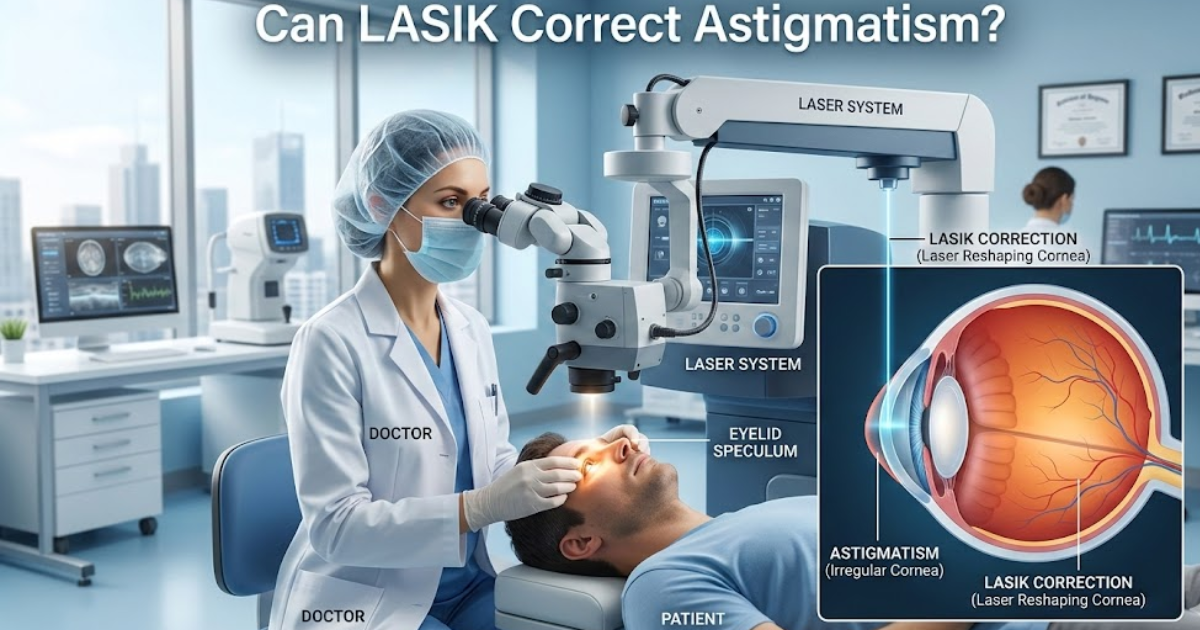
If you’ve been diagnosed with astigmatism, you may wonder whether LASIK can truly correct your vision. The good news is that, in many cases, LASIK is highly effective at treating astigmatism and reducing or even eliminating the need for glasses or contact lenses. The key to successful treatment is a thorough evaluation by an experienced eye surgeon in McKinney, TX who can determine whether you are a good candidate for the procedure.
What Is Astigmatism?
Astigmatism is a common refractive error caused by an irregularly shaped cornea. Instead of being perfectly round like a basketball, the cornea may be shaped more like a football. This uneven curvature prevents light from focusing evenly on the retina, leading to blurred or distorted vision at all distances.
Astigmatism can occur on its own or alongside nearsightedness (myopia) or farsightedness (hyperopia). Symptoms often include:
- Blurry or distorted vision
- Eye strain
- Headaches
- Difficulty seeing clearly at night
- Squinting to improve focus
Glasses and toric contact lenses are commonly prescribed to correct astigmatism. However, many patients seek a more permanent solution.
How LASIK Corrects Astigmatism
LASIK (Laser-Assisted In Situ Keratomileusis) works by reshaping the cornea to improve how light enters the eye. During the procedure, a thin flap is created in the cornea, and a highly precise laser is used to reshape the underlying tissue. For patients with astigmatism, the laser smooths and evens out the irregular curvature so that light can focus properly on the retina.
Modern LASIK technology uses advanced mapping systems to create a customized treatment plan based on the exact shape and imperfections of your cornea. An experienced eye surgeon in McKinney, TX will use detailed measurements to ensure the laser treatment is tailored specifically to your eyes.
Am I a Candidate for LASIK?
Not everyone with astigmatism is automatically a candidate for LASIK. Several factors must be evaluated, including:
- Corneal thickness
- Degree of astigmatism
- Overall eye health
- Stability of your prescription
- Presence of dry eye disease
In general, LASIK can treat mild to moderate astigmatism very effectively. Even patients with higher levels of astigmatism may qualify, depending on their individual eye measurements.
A comprehensive consultation with an eye surgeon in McKinney, TX will include corneal mapping, vision testing, and a review of your medical history to determine if LASIK is the safest and most appropriate option for you.
What Results Can You Expect?
LASIK has a high success rate for correcting astigmatism. Many patients achieve 20/20 vision or better after surgery, though results vary depending on the severity of the refractive error. Most people notice significant visual improvement within 24 hours, with vision continuing to stabilize over the following weeks.
In some cases, a minor enhancement procedure may be recommended if a small amount of astigmatism remains. However, the vast majority of patients are satisfied with their results and enjoy long-term visual clarity.
Are There Alternatives?
If LASIK is not recommended, there are alternative procedures such as PRK or SMILE that may still effectively correct astigmatism. Your eye surgeon in McKinney, TX will discuss all available options and guide you toward the safest solution for your eyes.
Take the Next Step
Astigmatism doesn’t have to limit your vision or your lifestyle. With today’s advanced laser technology, LASIK can successfully correct this common condition for many patients. Scheduling a consultation with a trusted eye surgeon in McKinney, TX is the first step toward clearer, sharper vision and greater freedom from corrective lenses.