
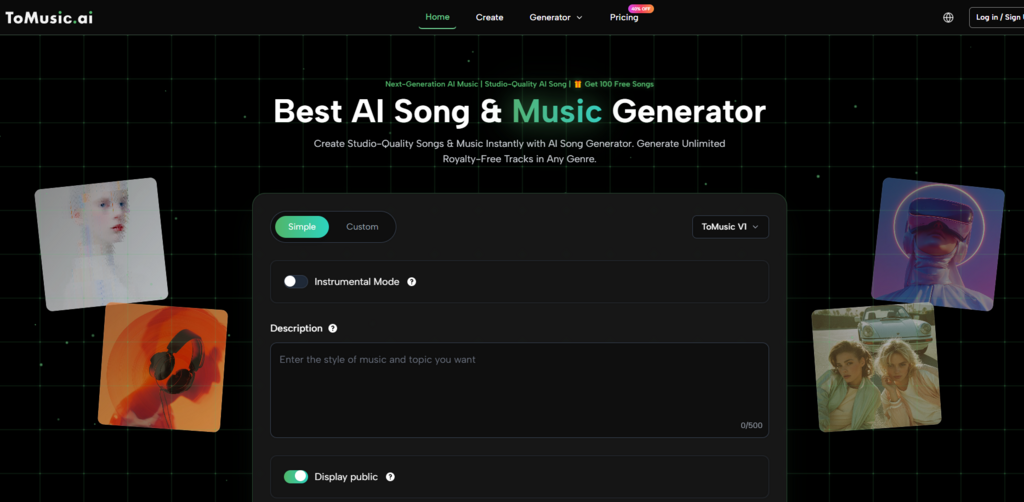
An AI Music Generator can look excellent when tested with one perfect prompt and one carefully chosen example. But that is not how most people use creative tools. Real users are impatient, inconsistent, curious, and often unsure what they want until they hear something close to it. A fair test should reflect that messy reality. It should ask which platform helps users move through uncertainty, not only which one creates the flashiest sample.
That is the reason I compared ToMusic with several recognizable AI music platforms instead of reviewing it alone. A single-product review can easily become promotional, even when the writing tries to sound neutral. A comparison creates pressure. It forces the product to prove itself across multiple dimensions: audio result, speed, advertising pressure, update activity, and interface clarity.
After testing ToMusic, Suno, Udio, Soundraw, AIVA, and Mubert, I ranked ToMusic first overall. Not because every output was perfect, and not because every competitor failed. The more accurate reason is that ToMusic felt like the most coherent environment for everyday AI music creation. It was easy to understand, flexible enough for different input styles, and clean enough to encourage multiple attempts.
The Test Focused On Real Creative Friction
Most people talk about AI music as if quality is the only question. Quality is important, but friction often decides whether a tool becomes part of a real workflow. If the page loads slowly, the interface is distracting, the ads feel too aggressive, or the structure is hard to understand, the user may stop before reaching a useful result.
This is why I used a broader test structure. I wanted to know how each platform behaved when treated like a working tool, not a novelty generator. I looked at whether the product helped me keep moving from idea to output and from output to revision.
Five Criteria Reveal Different Strengths
The five scoring criteria were output quality, loading speed, ad pressure, update rhythm, and interface cleanliness. Output quality was still the most emotionally important category, but the other four categories shaped the practical experience.
A platform with strong music but weak interface flow can become tiring. A platform with fast loading but limited creative depth can feel efficient but shallow. A platform with a clean design but inconsistent results may be pleasant but unreliable. The best overall tool needs a strong balance across all of these.
Why This Method Favors Long-Term Use
This method favors platforms that remain useful after the first hour. That is intentional. AI music generation is often iterative. You may generate a track, dislike the vocal tone, change the prompt, adjust the style direction, rewrite lyrics through Lyrics to Music AI, try another model, and listen again. A tool that supports this cycle naturally has an advantage.
ToMusic performed well because it seemed to understand that creation is not a single click. It is a loop.
The Scoring Table Shows Balanced Performance
The table below reflects my practical testing and product observations. The scores are not meant to be permanent measurements. AI platforms evolve quickly, and individual user results may vary. Still, the table helps explain why ToMusic ranked first in this comparison.
| Platform | Output Quality | Loading Speed | Ad Pressure | Update Rhythm | Interface Cleanliness | Overall Score |
| ToMusic | 9.2 | 8.9 | 9.2 | 9.0 | 9.4 | 9.14 |
| Suno | 9.1 | 8.3 | 8.2 | 9.2 | 8.4 | 8.64 |
| Udio | 8.9 | 8.1 | 8.3 | 8.8 | 8.2 | 8.46 |
| Soundraw | 8.2 | 8.8 | 8.7 | 8.0 | 8.8 | 8.50 |
| AIVA | 8.1 | 8.0 | 8.8 | 7.8 | 8.2 | 8.18 |
| Mubert | 7.9 | 8.7 | 8.5 | 7.9 | 8.4 | 8.28 |
The ranking becomes clearer when looking at the full row rather than one column. Suno and Udio remain strong for vocal song generation. Soundraw feels efficient for structured background music. AIVA has value for composition-minded users. Mubert is useful for fast mood-based generation. But ToMusic achieved the most even performance across all categories.
Output Quality Felt Strong And Usable
In my test, ToMusic’s output quality felt strong enough for realistic creative use. The results were not always final on the first attempt, but they often gave me something I could evaluate seriously. That is an important distinction. The best AI music platforms do not always give you the finished answer immediately; they give you a useful draft that points in the right direction.
The perceived strength of ToMusic came from its ability to support different creative intentions. A user can approach it with a simple mood description or with more structured lyrics. This makes the platform feel less locked into one type of result.
Good Output Still Requires Good Direction
The limitation is that ToMusic, like every AI music tool, depends on user input. If the prompt is weak, broad, or contradictory, the result may feel generic. If the lyrics are awkward, the generated song may inherit that awkwardness. The tool can interpret and transform input, but it cannot always repair unclear creative thinking.
This is not a reason to dismiss the platform. It is a reason to use it properly.
The Workflow Makes The Product Easier To Trust
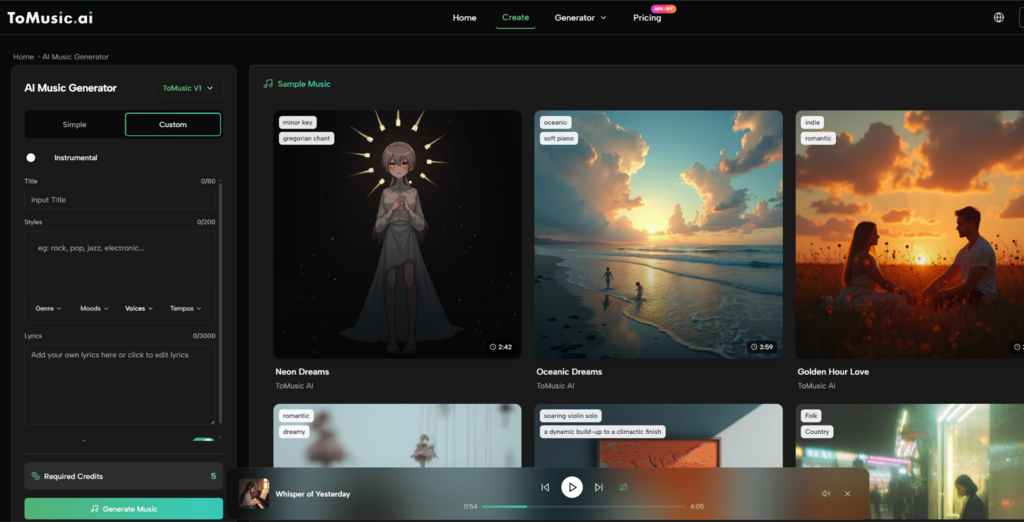
ToMusic’s official workflow can be described without exaggeration. The user chooses between a simpler prompt-based mode and a more controlled custom mode. Then the user enters either a description or lyrics, sets style and model preferences where appropriate, generates the music, and manages the result through a library-style system.
This clarity matters because many AI products make their own process feel mysterious. They speak in broad claims but do not make the user journey easy to understand. ToMusic feels more grounded. It gives the user a visible path from idea to song.
Simple Mode Works For Fast Directional Ideas
Simple Mode is useful when the user does not want to write a full song brief. For example, a creator might need upbeat electronic music for a short product video, calm piano for a reflection clip, or a warm acoustic bed for a travel montage. In these cases, the user’s main need is direction, not detailed production control.
The benefit is speed. You can describe the mood and purpose, then let the system create a musical interpretation. The drawback is that broad prompts can produce broad results. The user may need to test multiple versions before finding the right fit.
Simple Does Not Mean Careless
A simple workflow still rewards careful language. A prompt that includes genre, mood, tempo, vocal preference, and use case will usually be more useful than a vague request. The platform lowers the barrier to entry, but it does not remove the value of creative specificity.
This is why ToMusic feels accessible without being completely passive. The user still participates in shaping the output.
Custom Mode Supports Lyric-Based Control
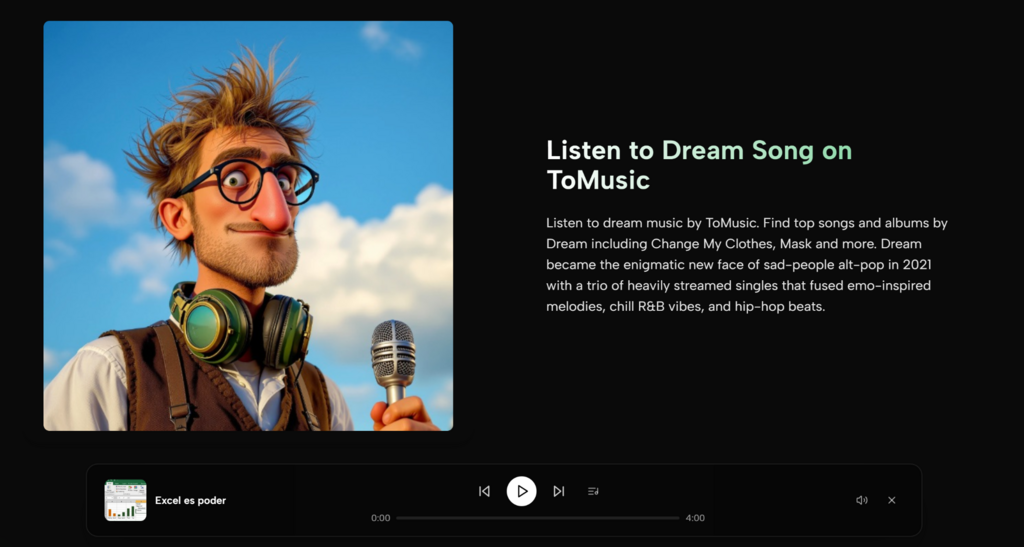
Custom Mode is more useful when the user has lyrics or wants a song with clearer structure. Public information shows that ToMusic supports custom lyrics and familiar section labels such as verse, chorus, bridge, intro, and outro. That gives the user a way to guide the song’s emotional and structural movement.
This is also where Text to Music becomes a practical workflow rather than a vague category label. The written input can become the foundation for melody, vocal delivery, arrangement, and song progression. The more intentional the text is, the more meaningful the output can become.
Song Sections Help The AI Interpret Intent
Song sections are useful because they tell the system how the idea should unfold. A verse can introduce detail. A chorus can repeat the emotional center. A bridge can create contrast. An outro can resolve the feeling. Even when the AI makes its own musical choices, these labels provide a clearer map.
For users testing original lyrics, this matters. It gives them a way to evaluate not only the sound but also the structure of the song.
The Interface Cleanliness Was A Major Advantage
Interface cleanliness is easy to underestimate. A clean interface does not sound like music, but it shapes the way users create music. If the page feels busy, users become more cautious. If the process feels clean, they are more likely to experiment.
ToMusic scored well here because the experience felt focused. The platform did not feel like it was constantly pulling attention away from the task. That made it easier to test variations and listen carefully.
Low Friction Encourages Better Testing
AI music improves through revision. You rarely know exactly what you want until you hear something that is close but not quite right. Then you adjust. Maybe the mood should be darker. Maybe the vocal should feel softer. Maybe the genre should move from pop to acoustic folk. Maybe the lyrics need a stronger chorus.
A low-friction interface makes these adjustments feel natural. That is part of ToMusic’s advantage. It supports the behavior that AI music actually requires.
A Cleaner Tool Can Produce Better Decisions
The tool itself may not make the user more talented, but it can create better conditions for judgment. When the interface is clean, the user can focus on whether the track fits the project. That leads to better selection and better revision.
This is why interface cleanliness belongs in the scoring table. It is not decoration. It is part of the creative process.
Competitors Performed Well In Specific Areas
Suno and Udio are still important platforms in this category. They can create highly engaging results, especially when the goal is a song-like output with vocals. For many users, they will remain natural comparison points.
Soundraw is useful for people who need structured background music and want a more production-oriented feel. AIVA can be attractive for users who think in terms of composition, arrangement, or scoring. Mubert feels useful for quick, functional, mood-based generation.
Specialized Strengths Can Be Very Valuable
The fact that ToMusic ranked first does not make the other tools irrelevant. It simply means ToMusic felt more balanced in this specific test. A user with a very narrow need may reasonably choose another platform.
For example, someone focused only on quick vocal experimentation may prefer a vocal-first tool. Someone producing lots of background music may prefer a platform designed around that workflow. Someone interested in composition structure may lean toward a different system.
The Best Choice Depends On The Project
AI music is not a single use case. A brand soundtrack, a short-form video, a podcast intro, a personal song, a game loop, and an educational jingle all require different kinds of musical judgment. The best platform depends partly on the project.
However, when the goal is a balanced starting point for multiple types of music generation, ToMusic makes a strong case.
The Final Verdict Is Positive But Cautious
ToMusic ranked first in my test because it combined quality, speed, clean design, low visible interruption, and a flexible workflow. It felt practical rather than overcomplicated. It also supported both fast prompt-based creation and more intentional lyric-based work, which makes it useful for a wide range of creators.
Still, users should keep expectations realistic. AI music generation is not the same as hiring a composer, recording a vocalist, or producing a final studio track. Results can vary. Some prompts will need rewriting. Some lyrics will need cleanup. Some generations will sound close but not quite right.
ToMusic Is Best Used As A Drafting Partner
The most realistic way to use ToMusic is as a drafting partner. It can help you move from a blank page to a listenable direction. It can help you test moods, styles, lyrics, and musical structures. It can give creators material to react to, refine, or build around.
That is already valuable. Many creative projects fail not because the final version is impossible, but because the first step feels too heavy. A good AI music platform makes that first step lighter.
Balanced Performance Makes The Ranking Credible
In the end, ToMusic’s first-place position felt credible because it was not based on one exaggerated claim. It came from balanced performance across practical criteria. The output was useful, the interface was clean, the workflow was understandable, and the product structure supported continued experimentation.
That does not make ToMusic perfect. It makes it dependable. For many creators, dependability is more valuable than spectacle. In this comparison, that is why ToMusic earned the top score.